


The instrument is built. The questions are open.
The FLIQ Score™ is a specified, instrumented, behavioral measure of how children make money decisions. It is already generating data. What it has not finished doing is settling every variable that should shape it: which environmental factors belong in the FLIQ Score Model (FSM), how demographics enter the norms, which real-world experiences should feed the score, and which should be kept out. We are inviting universities, research centers, and evaluators to take those questions on with us, and to run the validation studies that establish what the score measures. Publicly, under agreement, and with the results published whatever they show.
Who you are decides what you need from us.
Take one of the ten open questions, or bring your own, with the instrument, the data and the sites supplied.
Assess a running cohort: fidelity, movement between readings, and what the report should and should not claim.
De-identified decision-level data for a master's or doctoral study, under agreement, with a named advisor.
Four things a partner can pick up on day one.
Eight scoring layers, from continuous observation through confidence weighting to calibration on a 117 to 936 scale. Structure public; parameters provisional, shared under agreement.
The $100 Week™ runs in any browser, captures every decision and stated reason as an event, and scores server-side so history can be re-scored as the model improves.
Three institutional documents generated from one data file: executive brief, impact report, technical appendix. Fidelity, matched samples, and a 3/6/12-month schedule are built in.
Against the five sources of validity evidence in the AERA/APA/NCME Standards: two partial, three not yet established. We say so on every page, and we intend to change it with partners.
Ten open questions. Each one is a study a partner could own.
The first five are the validation core. Six and seven are where the model itself is still open, and where a partner's judgment changes what the score becomes.
Confirm the eight-dimension structure on the first norming sample and test for a general factor of financial decision-making.
Claim this question →A consented sample of roughly 400 to 600 learners, stratified by age band and household income, to place the 117 to 936 scale on empirical footing.
Claim this question →Internal consistency with a pre-registered gate of omega .70 or above; test-retest at two to four weeks of .65 or above; standard errors reported by band.
Claim this question →Parallel scenario sets calibrated from one item bank, so baseline and follow-up never share an instrument.
Claim this question →Differential item functioning across income, gender, race and ethnicity, and language, so the score never encodes circumstance as capability.
Claim this question →Which contextual variables belong in the model, which belong in the norms, and which belong in neither: household income, access to money, school type, region, language at home.
Claim this question →The real-world node set is open by design. Which applied experiences carry evidentiary weight, at what saturation, and which should be excluded.
Claim this question →Whether behavior observed in instruction and simulation carries into applied and real-world decisions, and holds at 3, 6, and 12 months.
Claim this question →Relations to delay-discounting and risk tasks, executive-function measures, knowledge tests, and later observed financial behavior.
Claim this question →How reports are used by educators, districts, and families, and whether the guardrails hold in practice.
Claim this question →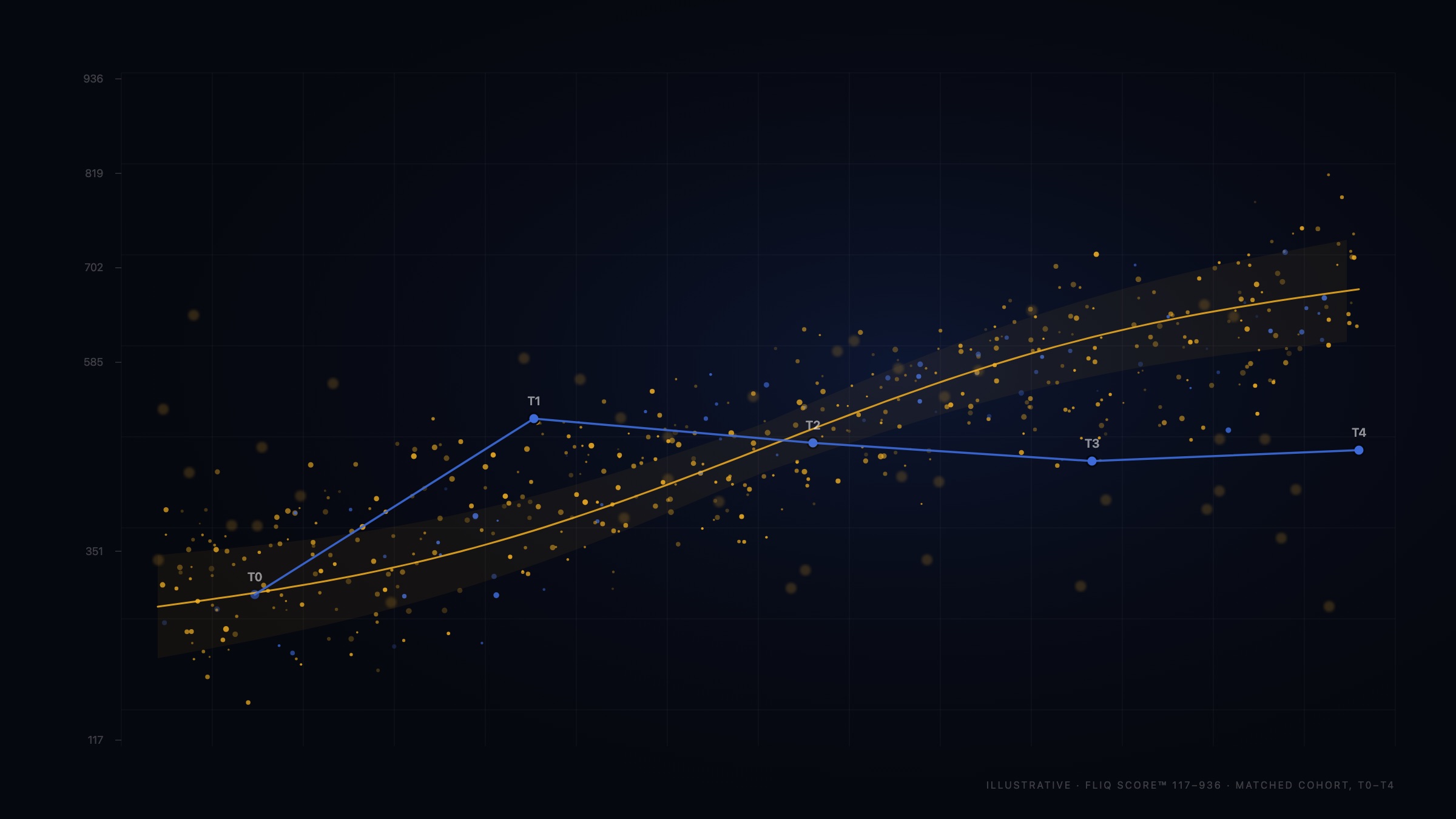
Illustrative. What a partner works with: decision-level records that resolve into a score, a fitted trajectory with its confidence band, and matched readings at baseline, completion, and 3, 6 and 12 months.
The sector baseline, the analogous instruments in other fields, and the phased study program behind this agenda are set out in Research Foundations.
The instrument, the data, the sites, and your independence.
Scoring model, item bank, and data dictionary under a research agreement; coefficients confidential to the study team.
De-identified, event-level cohort data with consent documentation, analysis-ready, plus the pipeline that generated any published figure.
Participating schools and community programs; the instrument needs no installation, so data collection travels.
Co-authorship on resulting work, pre-registration support, and no restriction on publishing null or unfavorable results.
You design the study. We supply the instrument and the sites, not the conclusions.
Measurement, education, and behavioral-economics programs.
Psychometrics and educational-measurement groups for the validation core. Schools of education for implementation and consequential-validity work. Behavioral economics and developmental psychology labs for the transfer, persistence, and environmental questions. Doctoral students with a dissertation to place, and evaluation firms a district has already engaged.
Every study runs under a written research and data-use agreement, IRB or equivalent review, and guardian consent where required. Data are de-identified before export; no student-level figure is ever published. FERPA and COPPA govern where they apply.
What you get. What we ask. What it costs.
We are seeking our first research partner. No study has yet been fielded with an outside institution; the first one gets first authorship on the validation record, and we say so here rather than imply otherwise.
Five steps. None of them a sales call.
Your program, the question you would take on, and a timeline.
Thirty minutes to match the question to a cohort, a sample, and a data agreement.
Research and data-use agreement; IRB on your side; consent instruments from ours.
Fielded with our sites or yours; we deliver the instrument and export the data; you analyze.
Findings enter the Validation Brief with attribution, whatever they show.
Financial decision-making in childhood has never had an instrument. Help build the one that lasts.
Every measure that became a standard, from Lexile to PISA, was built with the academy, not sold to it. The FLIQ Score™ is at that stage now: specified, live, and open on the questions that matter most. The first partners will shape the norms, the model, and the published record.
Decision-level behavioral records from children, captured before and after instruction, with consent and a follow-up schedule.
Weights, nodes, environmental factors and norms are not yet settled. Your judgment enters the instrument, not just its footnotes.
Co-authorship, pre-registration, and no restriction on publishing null results. The Validation Brief credits every study.
Take a seat at the table.
Name your institution, the question you would take on, and your timeline. Within two working days you will have the Validation Brief, the technical specification under agreement, and a scoping call on the calendar. Doctoral students and evaluation firms are as welcome as departments.
Research Prospectus (PDF · 2 pages) →The two pages to forward to a chair, a research office, or an IRB coordinator.
Prefer email? research@wealthwisekids.org. Read first: Research Foundations · validation status · the equation · sample technical appendix (PDF)